

Quick Summary: What This Blog Covers
This blog explains the Traffic Leads Revenue Gap and why increasing website traffic does not automatically lead to business growth. It highlights how weak lead generation systems, poor conversion paths, and misalignment between marketing and sales prevent visitors from becoming customers.
The article also explores strategies such as optimizing landing pages, improving lead nurturing, and tracking revenue focused metrics to transform traffic into qualified leads and measurable revenue.
Introduction
For many businesses investing in digital marketing, the first sign of progress is often an increase in website traffic. Analytics dashboards begin to show upward trends, social media engagement grows, and organic search visibility improves. At first glance, this appears to be a major win. However, many companies eventually discover that traffic alone does not guarantee meaningful business outcomes. The real challenge lies in understanding the traffic leads revenue gap and why it exists in the first place.
At Digital Maxima, we regularly work with businesses that have already achieved impressive visitor numbers but still struggle to convert that attention into consistent revenue. The disconnect between visitors, qualified leads, and actual customers is more common than most organizations realize. Bridging the traffic leads revenue gap requires a deeper look into strategy, user behavior, and the systems that guide prospects through the buying journey.
“Only about 2.35% of website visitors convert on average according to research by WordStream.”
This statistic highlights the core issue. High traffic numbers may look impressive, but without a deliberate framework designed to convert visitors into leads and customers, growth can stall quickly.
Understanding the Traffic Leads Revenue Gap
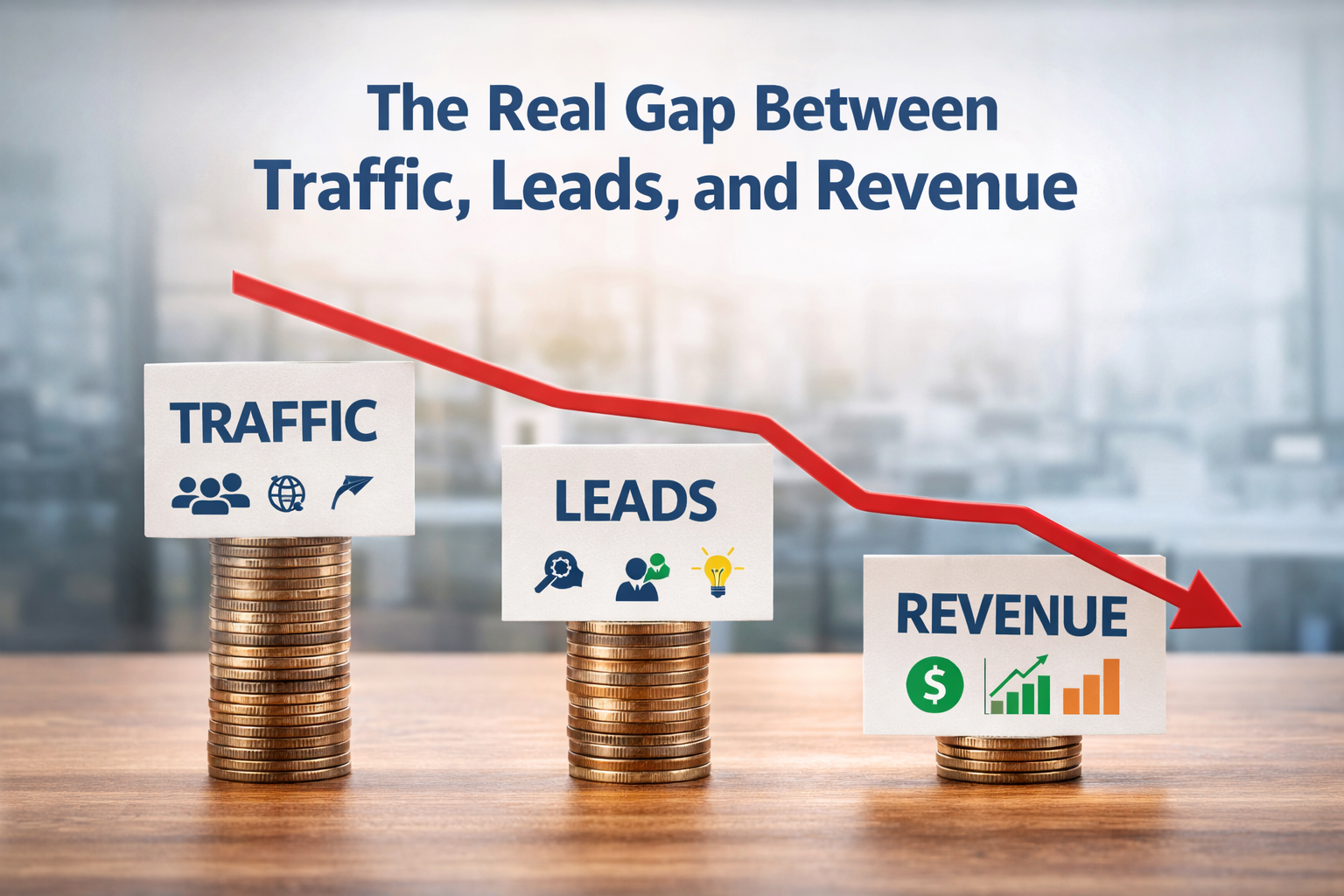
The revenue gap describes the disconnect between attracting website visitors, capturing qualified leads, and converting those leads into paying customers. Many companies excel at one of these stages while neglecting the others.
A typical digital marketing pipeline involves three major stages:
- Traffic acquisition
- Lead generation
- Revenue conversion
If any of these stages lacks alignment, the entire system begins to break down. For example, a company may run successful advertising campaigns through Google Ads and generate thousands of monthly visitors, yet their landing pages fail to capture contact information or guide visitors toward meaningful action.
Similarly, a website might collect hundreds of leads through forms but lack the nurturing process needed to convert those prospects into paying customers. Tools like HubSpot and Salesforce are commonly used to manage these pipelines, yet the technology alone does not solve the structural issue.
Understanding the traffic leads revenue gap begins with acknowledging that digital growth is not a single metric but a coordinated system of interactions.
Why Traffic Alone Can Be Misleading
Traffic metrics are often celebrated because they are visible and easy to measure. Platforms such as Google Analytics provide detailed reports showing user behavior, session duration, and page views. However, these numbers only represent the first stage of a much larger process.
Several factors can cause traffic numbers to rise without producing real business impact:
1. Unqualified Visitors
Search visibility may attract users who are researching general topics rather than looking for a solution. If the content strategy targets broad informational queries instead of intent driven searches, traffic grows while conversions remain stagnant.
2. Weak Value Proposition
When visitors arrive on a website but struggle to immediately understand what the business offers, they often leave without taking action. Clear messaging and positioning are essential to reduce the traffic leads revenue gap.
3. Lack of Conversion Pathways
Websites sometimes focus heavily on design and content while neglecting conversion mechanisms such as forms, consultation requests, downloadable resources, or product demonstrations.
4. Poor User Experience
A slow or confusing website can undermine even the best marketing campaigns. Research from Google PageSpeed Insights consistently shows that slower loading pages significantly increase bounce rates.
“A one second delay in page load time can reduce conversions by 7% according to research by Neil Patel.”
Each of these issues contributes directly to the widening traffic leads revenue gap.
The Role of Lead Generation in Closing the Gap
Generating traffic is only the first step. To move visitors toward becoming customers, businesses must implement effective lead generation systems. Lead generation serves as the bridge that connects attention with potential revenue.
Companies that successfully reduce the traffic leads revenue gap typically implement several key tactics.
Create Strategic Landing Pages
Landing pages designed for specific campaigns help focus visitor attention on a single action. Instead of presenting multiple options, these pages guide users toward submitting information, requesting a consultation, or downloading valuable resources.
Many organizations use tools such as Unbounce to create conversion optimized landing pages tailored for different audience segments.
Offer Meaningful Lead Magnets
Visitors are far more likely to share their contact information when they receive something valuable in return. Examples include:
• Industry reports
• Practical guides
• Strategy templates
• Case studies
When these resources align with user intent, they naturally narrow the traffic leads revenue gap by transforming anonymous visitors into identifiable prospects.
Optimize Calls to Action
Calls to action play a crucial role in guiding user behavior. Simple improvements in wording, placement, and visual design can dramatically increase conversion rates. Platforms like Optimizely enable businesses to experiment with different variations and determine which versions perform best.
Turning Leads Into Revenue
Even when businesses generate a strong flow of leads, many still struggle to convert those opportunities into revenue. The final stage of the traffic leads revenue gap occurs when leads enter the sales process but fail to move forward.
Several structural issues often contribute to this problem.
Weak Lead Qualification
Not all leads have the same level of readiness. Without proper qualification systems, sales teams may spend significant time pursuing prospects who are not yet prepared to buy.
Customer relationship management systems such as Zoho CRM help businesses assign lead scores and prioritize high value opportunities.
Lack of Lead Nurturing
Many prospects require multiple touchpoints before making a purchasing decision. Email marketing platforms like Mailchimp allow businesses to build automated sequences that educate, nurture, and guide prospects toward conversion.
Misalignment Between Marketing and Sales
One of the most overlooked causes of the traffic leads revenue gap is poor communication between marketing and sales teams. Marketing departments may focus on generating high volumes of leads while sales teams prioritize quality and readiness.
When both departments operate without shared metrics or feedback loops, opportunities are frequently lost.
Data Driven Strategies That Bridge the Gap
Closing the traffic leads revenue gap requires a unified approach that connects marketing performance with real business outcomes. Data driven strategies allow organizations to identify where visitors drop off and why conversions fail to occur.
Several best practices consistently produce measurable improvements.
Track the Entire Customer Journey
Businesses often measure top of funnel traffic but overlook the stages that follow. Mapping the entire journey from first visit to final purchase provides clarity on where prospects disengage.
Focus on Intent Based Content
Content strategies should prioritize search queries that signal buying intent rather than purely informational topics. By addressing real customer problems and solutions, companies naturally attract more qualified visitors.
Align Marketing Metrics With Revenue
Instead of celebrating traffic growth alone, companies should evaluate metrics such as:
• Lead conversion rate
• Cost per lead
• Customer acquisition cost
• Revenue per visitor
When organizations shift their focus toward these indicators, the traffic leads revenue gap becomes easier to identify and resolve.
Building a System That Converts Attention Into Growth
The most successful digital strategies treat traffic, leads, and revenue as interconnected components of a single system. When one area improves without supporting the others, the imbalance creates friction that prevents sustainable growth.
Businesses that successfully eliminate the traffic leads revenue gap tend to share several characteristics:
- Clear messaging that communicates value immediately
- Conversion focused website design
- Strong lead capture mechanisms
- Automated nurturing systems
- Close collaboration between marketing and sales
This integrated approach ensures that every visitor interaction contributes to measurable business outcomes.
Final Thoughts
Growing website traffic can be exciting, but it is only the beginning of the digital growth journey. Without the right systems in place to convert visitors into leads and leads into customers, even impressive traffic numbers can fail to deliver meaningful results.
Understanding the traffic leads revenue gap allows businesses to move beyond vanity metrics and focus on strategies that truly drive growth. By optimizing every stage of the customer journey, organizations can transform online visibility into measurable revenue.
At Digital Maxima, our team focuses on helping businesses close the traffic leads revenue gap by aligning marketing strategy, website performance, and conversion systems. If your organization is seeing strong traffic but limited revenue impact, it may be time to examine the structure behind your digital marketing efforts and identify where the real opportunities lie.
To explore how a strategic approach can close the traffic leads revenue gap, visit our internal resource on digital marketing consulting services and discover how a connected strategy can transform traffic into measurable growth.
Frequently Asked Questions
1. What is the traffic leads revenue gap?
The traffic leads revenue gap refers to the disconnect between attracting website visitors, converting them into qualified leads, and turning those leads into paying customers.
2. Why does high website traffic not always lead to revenue?
Many websites attract visitors who are not ready to buy, lack clear calls to action, or fail to guide users through an effective conversion process.
3. How can businesses reduce the traffic leads revenue gap?
Businesses can reduce the gap by improving landing pages, creating stronger lead magnets, implementing nurturing campaigns, and aligning marketing with sales teams.
4. What tools help track the traffic leads revenue gap?
Platforms such as Google Analytics, HubSpot, Salesforce, and Zoho CRM help businesses track visitor behavior, manage leads, and measure conversion performance.
5. Why is lead nurturing important for revenue growth?
Lead nurturing helps educate prospects and build trust over time, increasing the likelihood that potential customers will eventually make a purchase.